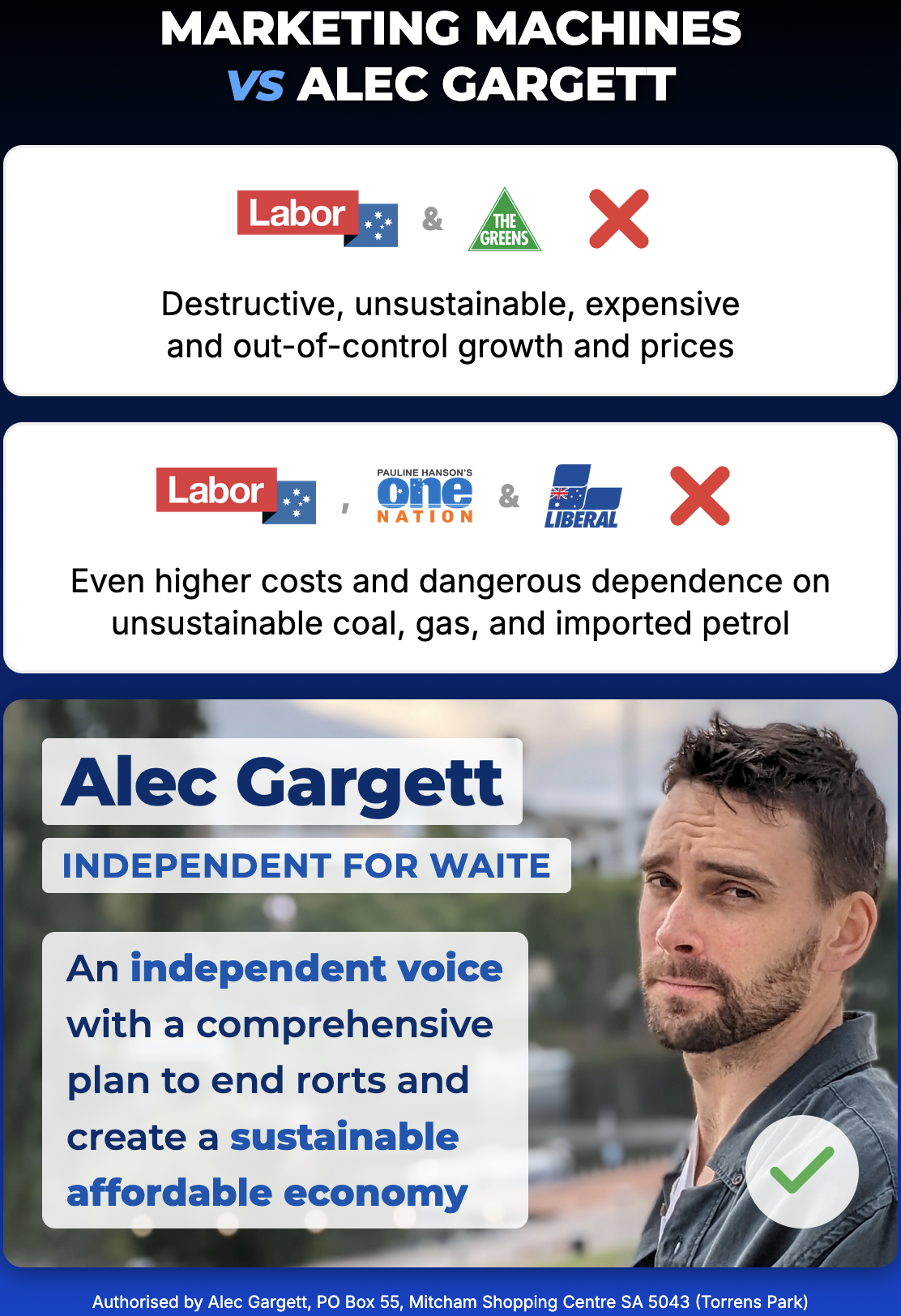
Hi. I'm Alec Gargett, and I'm running as an Independent for Waite, and I have a plan for an affordable, sustainable economy, ending the out-of-touch dependence on unsustainable growth, pollution and rising prices.
I was born at Blackwood Hospital in 1988 and have spent almost all of my life in Waite.
I attended the University of Adelaide, and have a BA and two graduate certificates, one in International Security and the other in Data Science.
On top of this, I've spent an additional 15 years teaching myself other relevant skills and knowledge, and doing the deep thinking that is lacking from parliament, and now I have a plan.
Not everyone has the time to read the full 10,000-word plan, so here are some of the highlights:
Create a PBS-like system that regulates everyday costs down when profit margins are too high, or negotiates a price limit in exchange for a subsidy and a zero-interest loan for home and vehicle efficiency upgrades, including electrification.
Regulate against the destruction of our beautiful homes, gardens, surroundings and environment, and blocking out of views of nature by lower quality housing.
Make our algae science independent from polluting industries and political bias. Currently there are conflicts of interest.
Upgrade public transport with electrification and increase the number and frequency of services.
Oppose new wasteful spending by political parties like Labor's $285 million failed hydrogen project. Get the priorities right.
Use State Parliament to call out the federal government on all of their failures, including inadequate funding for the states, extreme growth, pollution and rising prices, and advocate for central bank reform
Lead a movement to make parliament more competent at both state and federal levels
Watch a few of my videos or skim through my website and decide for yourself which candidate has the problem-solving skills and analytical skills that are most lacking from parliament.
If you think that's me, I'd appreciate your support as your Independent for Waite.
InDaily article
An article about me and other independents running in South Australia was published by InDaily. It's a nice article, but the quotes they've included won't make as much sense out of context, so here is the full piece that I sent them:
Why have you decided to stand at the March 2026 state election?
Someone has to tell the whole truth. We are in serious danger.
Our quality of life is already declining or under threat due to incompetence from all parties. Experts and common sense are both telling us that things will get a lot worse.
We need more dynamic parliaments at both state and federal levels to solve this, and that starts with an independent thinker like me in state parliament telling the truth.
Why are you running as an independent?
Political parties are leading us toward disaster.
Every political party:
has some terrible policies;
dismisses some very serious issues, which leads both their followers and opponents to do the same;
divides many voters into irrational camps;
is failing to properly tackle some of our most serious problems;
prevents a level playing field for candidates;
and prevents meritocracy and truth-telling in our parliament.
What are the main issues you are running on?
Inadequate leadership on cost of living, quality of housing, protecting our suburbs, and properly addressing our environmental issues.
Failure of the state parliament to call on the federal government for funding transport and education and central bank reform, and to call out their failures.
The algae crisis and the lack of independent science due to SARDI, the institute in charge, being part of the mining and farming department PIRSA. I’ll support ending conflicts of interest and funding the EPA to give us a comprehensive breakdown of the nutrient pollution sources.
The ramping crisis and the lack of local hospitals, local doctor training, at-home care and local aged-care capacity.
Has there been much support for your campaign?
Many people I’ve spoken to have been open-minded, and then quite enthusiastic once they've heard my pitch. Some voters are so attached to a particular party or politician already that they’re not interested in a fair go, but a much larger number probably haven’t even heard of me yet because they understandably avoid politics as much as possible. I will need your support to be able to reach these people.
Why do you think we’re seeing more independents run in elections?
Some people are realising that political parties have crippled our political system.
Others are recognising the value of having a representative who will independently advocate for the electorate, which should be the majority of the job.
What’s one thing you’d like to see change in South Australia?
A more dynamic parliament with stronger independent voices, resulting in better policy development.
Watch my videos
Most people won't want to read all 10 000 words of the summary of my plan on this website, which is fine.
The most important ideas behind my campaign are explained in the 90-second videos that are found here and on my social media accounts.
You can find me on social media using the links above. My facebook page is the best place to support me and watch a couple of videos, and my Youtube page is the best place to watch additional videos.
Here is another 90-second video introducing some of the core ideas behind my campaign:
You can click here to skip straight to a summary of my policies. Despite having so much policy detail, they are arguably not the most important part of my platform.
I can't implement or even perfect such a plan on my own. What I can promise to do is to work hard to influence state and federal governments. I will:
Work collaboratively with them; discussing issues with them directly;
Publicly elucidate their failures where necessary, if positive collaboration fails;
Support other good independent candidates at subsequent federal and state elections, to create a national movement towards better politics;
Use the platform of parliament to better advocate for our state and our electorate;
Perhaps even more importantly, whether I win or not, your vote will send a message to State Parliament, Federal Parliament, and potential candidates across Australia about the quality of policy thinking, problem solving and political system that Australians want to see.
The only thing we need to solve all of the above crises is better policy,
and the only thing we need to do to get better policy is to encourage independent, ambitious policy thinkers to run for office, and get them elected.
We need to elect people who will think and speak independently about better policy and better politics; who are passionate about doing that, capable of doing it, and free to do it; who can collaborate positively with everyone else in parliament across party lines to help get good policy through parliament, while maintaining the freedom to independently advocate for their electorate, and who will use the platform of parliament to support the movement towards a better way of doing politics in Australia.
It's not just about how the candidate is going to vote in parliament or whether they will be in government or hold the balance of power.
It's about how the candidate will use the platform of being a member of parliament to hold both state and federal governments accountable. It's about how willing the candidate is to advocate for better policy in a way that appeals to the whole political spectrum. But most of all, it's about the message that you will send to the houses of parliament and to Australia by voting for that candidate. Do you want to send the message that Australians are satisfied with our political parties and will vote for them no matter what, or do you want to send a message that Australians will support independents if political parties won't do better? The more support I get, and the more votes I get, the more encouraged deep policy thinkers will be to put themselves forward at the next federal and state elections, and the more accountable politicians and political parties will have to be to get elected.
Fundamentally, voting for me is about sending a message.
We need to send a message to the federal and state government and the corporate political parties, and we need to create a new type of politics in Australia. To do that, we need to support a movement of candidates who demonstrate through their own policy suggestions and discussion that they are putting their electorate's goals ahead of their party's agenda or any other agenda, and that they have the necessary policy passion, the necessary deep thinking, and the necessary independence, to contribute substantially to solving our problems.
There are three crucial components to my plan:
Ambitious policy solutions to all of the crises above, which are detailed below and will be improved further over time, including through feedback from the electorate;
An ambitious plan to change the way politics is done in Australia for the better;
A viable and simple political strategy: to draw positive attention to these ideas in a non-partisan way.
Together we can send a message to both federal and state governments that if they won't do their job well enough, we'll elect someone who will. At the same time, we can send a message to independent policy thinkers in the community that we will support them if they run for office. Together, these two messages will result in a government that is much more accountable, that tries much harder to solve our problems, and has the necessary policy skills to do so.
Sometimes it seems like many of our politicians aren't even trying. They play around the edges; throw a lot of money at problems without solving their causes; choose policies that mitigate some problems while making other problems worse, or throw a lot of money at something in a way that barely addresses any problems at all. Sometimes they choose a hopeless political strategy to boot, and for almost all political parties it's a divisive strategy.
My plan involves a comprehensive set of policy solutions, respect for the whole community, and a pragmatic strategy to support a democratic political movement beyond our own electorate here in Waite, and beyond state politics, to influence politics for the better at the federal and international levels. We need better policies and we need a better way of doing politics. If I'm elected, I'll use the platform of State Parliament to do my part in both.
By the election in March, I'll get my plan across to as many people in Waite as I can, and I could use your support.
If you follow me on social media or video platforms, you can see my videos and perhaps even share them around. This would be a great help, as would sharing this website with whoever you think might be interested.
If you would like to donate, I can legally take donations of up to $5000, but even a few dollars would help, so email me if you'd like to donate. I'll be competing with people who are allowed to spend up to $100 000 on their campaign.
Best wishes,
Alec Gargett
Why so much policy detail?
This website contains over 7000 words of policy discussion including thousands of words of my own policy suggestions, and I don't expect most of you to read all of that. Nor do I think I should be deciding policy by myself.
My policy suggestions are described in detail below:
for those who are interested in the details;
to demonstrate my passion and my capabilities when it comes to thinking independently about policy and politics;
to ensure accountability;
to assist policy discussion with those who are interested;
and to support further policy development.
However, it's important to understand that politicians should really only have one job:
to ensure their electorate is being served as well as possible by government departments.
That means providing government departments with:
the right powers;
the right limitations on their powers;
the right oversight;
the right internal leaders;
and the right amount of funding.
If politicians just did this one job well enough, government departments would be collaborating with others, including non-departmental experts and the general public, to do all of the other necessary policy-making with integrity, with politicians providing the oversight to ensure that their work is aligned with democratic preferences and the best available evidence. Currently this isn't happening. In order for politicians to manage government departments well, they need to be capable of thinking critically and independently about policy, and we need to support the candidates who have best demonstrated that ability through their policy writing and their policy communication.
Ideally, a political candidate should be passionate enough about policy to publish thousands of words of their own policy detail that they have written themselves on their own initiative. Electing politicians who are committed to doing that and free to do that is the only way to ensure accountable, passionate, competent and dynamic policy development.
Candidates don't need to be perfect at policy. Nobody is. Policy is not a precise science. You don't need to agree with all of a candidate's policies. Most people aren't even interested in policy and that's OK. You don't need to read every detail. But at the very least, you need to know that the details are there, and that the details are theirs. You need to know that they are capable of thinking independently about policy for their own electorate, because that's their job, and if we don't elect political candidates who have demonstrated that they are committed to doing that job and free to do that job, they won't, and that's why they aren't.
In the end, all of the above crises could be solved with just one policy if it were implemented well enough:
Ensure that anyone who can help to solve any crisis is encouraged to do so and fairly paid if they want pay. As part of that, ensure that any well-meaning person who wants to work in policy development is allowed fair involvement.
In other words, if enough people including competent experts were adequately paid to work together on solving our problems, they would solve our problems. But ensuring this is implemented well enough requires voters to take action to encourage independent policy thinkers to run for office and get them elected.
My initial policies
Most people won't have the time to read all 7000 words of my policy detail, so here are some of the highlights:
Create a PBS-like system that regulates prices down when profit margins are high on a broad range of essentials, or negotiates a price limit in exchange for a subsidy and a zero-interest loan for home and vehicle efficiency upgrades.
Regulate against the destruction of our beautiful homes, gardens, surroundings and environment, and obstruction of views of nature by lower quality housing.
Make our algae science independent from polluting industries. Currently there are conflicts of interest.
Upgrade public transport with electrification and increase the number and frequency of services.
Oppose new wasteful spending by political parties like Labor's 200-million-dollar failed hydrogen project.
Call out the federal government on all of their failures.
Since I will work for the people of Waite, my priorities have to be determined by the people of Waite. I will always be seeking to further improve my policies and ensure they are aligned with the wishes of the electorate, including in response to feedback from the people of Waite. Please send any feedback to alecgargett@gmail.com.
If I'm elected, I will continue to develop these policies, make more short videos to explain each of them, and add a comment section to this website so that others can contribute.
One of the first things I will do if elected is to use the resources of my office to survey the people of Waite to democratically determine what my priorities will be.
Here is a (very) quick summary of most of my policies:
The following contents list also serves as a summary of my policies for those who aren't interested in every detail.
Reduce bills by providing zero-interest loans and subsidies for efficiency upgrades including solar water heating and electrification at regulated prices
(1.1_Efficiency_Loans)
Provide zero-interest loans and subsidies for purchases that reduce costs and increase efficiency such as purchasing electric cars, switching to electric heating, adding solar water heating, buying a vehicle-to-home inverter, or repainting a dark roof to a heat-reflecting white. This will be designed to reduce prices by providing only enough to make the difference up to a target price.
Provide cheap electricity and cheap healthy foods
(1.2_Cheap_Essentials)
Reduce prices on essentials like electricity, and healthy, environmentally-friendly protein sources for South Australians through investment or through regulation and compensation. In a similar manner to the Pharmaceutical Benefits Scheme, the government will negotiate and regulate to reduce the price of some essentials for South Australians, and compensate only the amount needed to ensure adequate supply and good quality. Reducing the cost of electricity will help to reduce pollution, by helping people switch from polluting gas and wood burning to electricity. Support and expand the government's policy to make electricity free at times when there is a surplus of electricity on the grid.
Tax reform
(1.3_Taxes)
Cut taxes on ordinary Australians. Raise taxes on multinationals and income above $500 000 per year (or more than ten times above the median average income).
The tax system should be designed to prevent individuals from earning more than 10 times the median lifetime income, and if they have already earned more than this in net income, their assets should be taxed if necessary to compensate.
Increase wages faster and reduce unemployment
(1.4_Wages)
Increase wages faster and reduce unemployment by requiring the Fair Work Commission to:
Take into account the real increase in cost of living and housing at constant quality, not just CPI, to increase wages across the board;
Introduce penalty rates for those working over 30 hours a week;
Increase penalty rates for those working night shifts or having to commute at rush hour;
Ensure that gig workers are paid at least minimum wage after expenses.
Reserve Bank Reform
(2.0_RBA_Reform)
Reduce cost of living and interest rates by giving the Reserve Bank other ways to control inflation, like charging multinationals and those earning more than a million per year for inflationary behaviour
Require the Reserve Bank to develop a new cost of living index, in addition to the CPI. The new cost of living index would be designed to accurately measure changes in the overall cost of living including interest payments and applying the constant quality principle to housing (such as location and total size of the property), neither of which is involved in the CPI.
Housing
Assist home buyers but counteract hyperinflation by regulating large-portfolio property investment
Housing policies from our political parties threaten two opposite extremes:
One set of policies tries to assist buyers in ways that simply hyperinflate property prices and as a result fails to make housing more affordable.
The other set of policies threatens to crash the housing market, which most voters won't accept.
The solution requires a comprehensive set of policies addressing and balancing all sides of the equation. My solution finds a balance between:
Providing government loan-assistance to home-buyers up to a regulated maximum price, ensuring that home-owners don't lose value on their primary residence;
Regulating large-portfolio property and land investment, preventing hyperinflation and price gouging.
Provide zero-interest or low-interest loans to the current long-term renter or a chosen prospective resident to cover the gap to a regulated price
(3.0_Assist_Buyers)
Assist prospective homeowners by allowing zero-interest or low-interest loans for the buyer.
My policies will prevent this from excessively inflating housing prices further for two reasons:
Firstly, the loan will be no greater than necessary to allow the buyer to make up the difference in their buying power to a designated price limit, and only a designated buyer will get access to this loan;
Secondly, due to Policy 4 below, property investors will be incentivised or required to sell to the rightful resident at such a designated price, rather than sell to someone else, and this price limit will be stricter for large-portfolio investments than for a primary residence, as explained below.
Regulate who land and housing investors must offer their properties to and how much they can charge
(4.0_Regulate_Investment)
We've all heard horror stories of renters failing to get the repairs and upkeep they need from their landlords.
We've also heard stories of long-term renters being kicked out of their home where they'd been living for years or decades, just so that the property can be sold to someone with more money, or rented out as an Airbnb.
Most of us recognise both of these examples as an injustice. The fact that these injustices are allowed also incentivises an unfair housing market, which contributes to the housing crisis. Furthermore, both examples indicate that legal property rights have become too disconnected from moral property rights, which causes other injustices and further contributes to the housing crisis.
To solve both of these issues we could:
4.1 Require large-portfolio land and housing investors to pay for an assessment of investment properties by a dedicated government agency. This agency will then use this assessment to set a limit on the rent and the sale price, based on the property assessment and a democratically determined housing price growth limit. This limit will be high enough to prevent housing prices from crashing, and allow home-owners to maintain the value on their primary residences, but low enough to prevent hyperinflation and price gouging by large-portfolio investors.
4.2 Incentivise or require wealthy property investors to offer their properties to any past residents in order of how long they have lived there, so that those with the greatest sentimental attachment to the property have the option to buy or rent the property at no more than the price limit.
4.3 If there are no past residents who are interested in buying or renting the property at the offered price (no more than the price limit), the agency will determine which applicant it should be sold or rented to based on their degree of need.
Negative gearing
Negative gearing operates primarily through the federal tax system, but implementing the above reforms, if they spread to other states, would allow the safe abolition of negative gearing by property investors, including by abolishing the capital gains tax discount for investment properties.
In the meantime, it would also allow state-level capital gains tax on large-portfolio property investors.
Build housing the right way, protecting the beauty of our suburbs and our hills
(5.1_Build_Better)
5.1 The policies above and below may be enough to solve the housing affordability crisis, but we also need to improve the quality of housing that people can afford by building the right type of high-quality housing in the right locations, instead of destroying the beauty of our existing suburbs and wasting land on the outskirts with a lack of proper planning. With all of the above policies, we won't need to sacrifice our quality of life to reduce the cost of living any longer. We can replace ugly buildings with beautiful ones, instead of replacing beautiful buildings and gardens with ugly ones, and we can plan new land releases better to use the land more efficiently with higher quality housing with a wide variety of densities, including public housing, along with adequate space for new hospitals and other necessary amenities and infrastructure.
In order to reduce commute times and efficiently use land, we should also investigate the possibility of creating new business districts at the far outskirts of our suburbs, for example, beyond the northern outskirts of Adelaide's suburbs.
5.2 Ban the destruction of beautiful homes, gardens and heritage buildings against the will of the community and any developments that deface the Adelaide Hills.
Hospitals, aged care and urgent care
(6.0_Better_Care)
Provide abundant, high-quality aged care and at-home care to quickly solve the ramping crisis
To improve quality of life and reduce the burden on our hospital system we can:
6.1.1 Build government-owned aged care centres to ensure adequate supply of high-quality care at affordable prices.
6.1.2 Fund a program of roving nurses to provide both aged care and urgent care in people's homes.
Increase the number of hospitals, emergency departments and staff
(6.2_More_EDs)
Increase the number of hospitals and emergency departments, the size of emergency departments, and increase the number of staff, and the number, quality and affordability of aged care centres. We can:
6.2.1 If feasible, reopen hospitals that are no longer being used as hospitals, such as the Blackwood Hospital.
6.2.2 If feasible, reopen emergency departments that have been closed, like the emergency department at the Repat.
6.2.3 Build new hospitals, and design them to efficiently provide the most desperately needed services. Not every hospital has to be huge. Small hospitals are quicker to build.
6.2.4 Allow more Australians to study medical degrees and clinical psychology in South Australia.
6.2.5 Allow psychologists to assist psychiatrists in mental hospitals.
6.2.6 Hire more social workers and occupational therapists to assist psychiatrists in our mental hospitals.
6.2.7 Investigate the viability of specialist graduate medical programs at our universities, so that qualified health professionals can become specialist doctors by learning only what is relevant to a chosen specialty.
6.2.8 Create a new position in emergency departments called a medic, ranked between a nurse and a doctor, who specialises in the intermediate work that lies around the overlap between the work of nurses and doctors, improving care through specialised emergency department training and encouraging both genders to work in this kind of role.
6.3 Increase the number of rehab facilities.
How will we pay for this?
Solving every major crisis we are facing will cost the government money. We need to fund cost of living measures and better housing policies, build and staff more hospitals and aged care facilities, hire more community nurses and doctors, create more emergency departments, hire more police officers and new Police Support Officers, provide loans to people for efficiency upgrades and electrification of their homes, invest in producing essentials cheaply, develop something similar to the Pharmaceutical Benefits Scheme for non-pharmaceutical essentials, and more, all detailed below.
Luckily we have big corporations with large profit margins that can afford to pay, along with hundreds, perhaps thousands, of decamillionaires. We also don't charge corporations and other countries enough for our finite natural resources such as minerals. South Australia has more money coming in from minerals (per capita) than Victoria, New South Wales, the ACT or Tasmania. These sources and other large export industries provide us with an ample base to generate revenue while reducing costs for ordinary South Australians.
However, Western Australia exports far more of our finite natural resources than any other state, so ideally we also want the federal government to charge for these resources, and provide states with the funding we need to solve the crises we are facing. Unlike most other politicians, I have the independence necessary to use State Parliament as a platform to call on the federal government for the funding we desperately need.
In the meantime, we need to charge for our own export resources in order to fund the solutions to the crises locally. You can read more about this in the article "Paying for good policy" underneath the policy section.
Call out the federal government for underfunding South Australia
(7.0_Federal_Underfunding)
Despite having more money coming in from minerals (per capita) than Victoria, New South Wales or the ACT, our life expectancy and incomes are lower, and South Australian government debt is almost $40 billion and forecast to rise to almost $50 billion by the end of the decade. A portion of this debt is due to improper spending, but cutting such spending by itself will not be adequate to address all of our crises and the debt at the same time.
In fact, some of the crises we are facing are so dire, that borrowing money in order to fix them is actually good fiscal policy. But relying on debt more than we need to is irresponsible, and underfunding from the federal government is largely to blame.
The federal government gives our natural resources away to corporations without charging properly for them, fails to adequately tax billionaires and decamillionaires, and then fails to provide struggling states like South Australia with adequate funding for our desperately failing services. I will use the platform of State Parliament to call on the federal government to fund struggling states like South Australia properly. Even more importantly, voting for me will encourage other prospective independents to run at the federal election with similar policies.
Stop giving our resource wealth away (almost) for free
(8.0_Resource_Pricing)
Natural resources under the ground legally belong to the state, which means they belong to all South Australians. Giving away these resources to large corporations for pennies is one of the biggest rorts in our history. Ideally, the Quality of Life Commission (detailed below) would directly charge whatever price maximises benefits for South Australians, but this may require constitutional reform, or implementation at the federal level. Until then, the Quality of Life Commission will instead recommend minimum resource prices to parliament, both for existing mines and separately as the reserve price when selling resources for new mines at auction. These resource sales will fund not only the Commission itself but all of the other policies below, including cost of living measures. Other environmentally costly international export industries may also be charged for those exports, where the Commission regards these charges as necessary to fund necessary policies, or otherwise beneficial to quality of life in Australia.
The Quality of Life Crisis
All of the crises I mentioned above, including the cost of living crisis, together cause an even bigger and more fundamental crisis: the quality of life crisis. Attempting to reduce the cost of living by reducing our quality of life is not a real solution, since fundamentally the main crisis we are trying to solve when we address cost of living is a quality of life crisis. My policies address this by addressing not only the cost of living crisis but all of the crises listed above.
With technology improving, quality of life should be improving too. Instead, we are seeing a decline in quality of life, especially when it comes to the quality of housing that people are living in.
Create a Quality of Life Commission
(9.0_QLC)
Solve the cost of living crisis and the quality of life crisis, by creating a Cost of Living and Quality of Life Commission, which I will refer to here simply as the Quality of Life Commission.
Give the Quality of Life Commission the power to:
9.1 Regulate against corporations and landlords contributing to the quality of life crisis;
9.2 Charge those corporations and landlords for harmful, inflationary or otherwise costly behaviour, advocating for constitutional reform or federal implementation to facilitate this if necessary;
9.3 Spend this revenue on reducing the cost of living and improving quality of life further; Advocate for constitutional reform or federal implementation that will allow us to further improve this commission by allowing it to implement its own variable charges;
9.4 Audit government spending to ensure that there is no waste including private contractor rorts, so that this money can be better spent on cost of living measures.
The Quality of Life Commission will also have the mandate and resources necessary to investigate the government itself for inefficient spending such as private contractor rorts, and to close regulatory loopholes in any sector that is being taken advantage of by bad actors.
This Commission will greatly increase the speed and efficiency with which we can address the quality of life crisis, compared to relying exclusively on the slow processes of a parliament that lacks the expertise for technical matters. It also means that parliament can direct the Quality of Life Commission to implement policies that require ongoing regulatory involvement.
Underemployment and immigration
Create a South Australian government employment service
(10.0_SAES)
Provide government-supported apprenticeships and job placements for all unemployed and underemployed Australians who want them by creating a South Australian government employment service. Expert in the field, David O'Halloran, PhD, recommends creating government employment services at the state level rather than at the federal level. Currently we have neither. The existing private services are inadequate. With the support of the funding from charging corporations and decamillionaires appropriately, the South Australian government employment service will ensure that everyone has the support they need to do the work that will most benefit South Australians, and that businesses that need support to help with this will be given that support.
More details on the unemployment and underemployment crisis
The official unemployment rate for South Australia (and Australia) in December 2025 was 4.0% (4.2% Australia-wide). The partial underemployment rate was 6.3% (5.9% Australia-wide), for a total official underutilisation rate of 10.3% (10.1% Australia-wide). Even this combined figure doesn't include all of the 20% of Australians who are not fully using their qualifications, not to mention the unknown number of Australians whose skills and knowledge are not being put to best use. This means that the true underemployment or underutilisation rate, in the broader sense, may be well over 20%. Unlike the piecemeal plans of our political parties, my plan outlined above will fully resolve this issue if well-implemented, especially Policies 6 and 7.
In the 2024 Graduate Outcomes Survey, over 30% of Computing and Information Systems university graduates reported that they did not have full-time employment 4 to 6 months after graduating, and of those with full-time employment, an additional 28% reported that they were not fully utilising their skills and education, meaning only about 50% were working full-time in an area that fully utilised their skills. Even within Engineering, 15% of graduates did not have full-time employment and an additional 23% reported they were not fully utilising their skills and education. For all degrees combined, 26% of graduates were not in full-time employment and an additional 28% of full-time employed graduates reported that they were not fully utilising their skills and knowledge. Many graduates are rejected from relevant jobs because employers prefer to bring people in from overseas with more impressive CVs. The federal Labor government plans to bring 1 million more people in on visas over the next 4 years, as part of a total increase in the population of 1.4 million, about the size of the entire city of Adelaide. This has benefits, especially for property developers, immigration lawyers, and large corporations that work to keep their profits high by keeping salaries low and their training costs low, but Australians have been gaslit by politicians and some of their followers on the downsides of this for everyone else, which only adds to the misguided hatred such as racism that they claim to oppose. We are told by politicians that several million more people per decade is necessary to address skills shortages and has negligible downsides, but there are over two million underemployed or unemployed Australians that can be trained to solve almost all of our real skills shortages, and who desperately need that extra income, many of whom already have the necessary education.
For a deeper discussion of the related underpayment crisis, and my creative writing, see my old artist website.
Employing people to work in policy development
Ultimately, every well-meaning person who wants to work in policy development in a democracy should be allowed fair involvement, and paid fairly if they want pay. Pay level above the minimum award rate and maximum hours should initially be proportionate to objective skills testing, and later that salary should be added to with bonuses based on democratic review and peer review of the quality of their contributions, and their quantity of contribution to implemented policies. No one should be denied the right to be involved with policy development in a democracy, and no one should be denied the right to adequate pay for such work.
Employing people to work in software and data science
Give modern businesses whose products or services are primarily software, websites, data science and so on a corporate tax exemption for at least the next 10 years.
Reduce net immigration without reducing the refugee intake
(11.0_Reduce_Immigration)
Support reducing the rate of immigration while opposing racism, opposing the mistreatment of immigrants and opposing reduction in the refugee intake.
Australia's population is projected to grow by 4 million over the next 10 years, according to the government's own report. Most of this is either people who come in on skilled visas or the family that they subsequently bring over. Very few are refugees and their family members. The birth rate per year is also more than 100 000 higher than the death rate as a result.
The left are currently empowering racist, xenophobic, anti-progressive, anti-science politicians by rejecting the more valid concerns and democratic rights of voters when it comes to immigration. During the COVID border closures, rents became cheaper. When businesses opened back up again, but international borders were still shut, unemployment dropped to the lowest rate in 50 years. And these are only the short-term effects. In the long-term, the quality of housing we are living in will continue to get worse if the population density in our cities continues to grow due to an intake of millions per decade, the rate that corporations and their political parties have chosen. It also increasingly makes it hard to solve other problems: harder to build enough public transport and eliminate traffic congestion and transport pollution, harder to reduce harm to our environment and animals through land use, resource use, production, construction and consumption.
The Albanese government's current plan is net immigration of around 230 000 per year, a rate of 2.3 million people per decade. The opposition's plan is to reduce this to a net intake of 130 000 per year, a rate of 1.3 million per decade. Neither has a comprehensive plan like my plan above to end our reliance on high rates of worker immigration.
In addition to this legal immigration, the federal government has estimated that there are more than 75 000 illegal immigrants in Australia, most of whom have deliberately remained in the country after their temporary visa is no longer valid. Corporations and their politicians treat this degree of lawbreaking as a non-issue because they profit from it.
We don't know how many of these 75 000 illegal immigrants are in South Australia because the government doesn't even estimate this.
Although immigration policy is primarily a federal government matter, it is important for me to have policies on this at the state level, since it sends a message to the federal government. Meanwhile, there are a number of things that can be done at the state level:
11.1.1 Solve the police staffing crisis with new Police Support Officers, as detailed in Policy 12.0, and ensure SAPOL have enough total staff to assist the Australian Border Force in enforcing immigration law.
11.1.2 Prevent businesses from employing illegal workers.
11.1.3 Reduce the need, demand, and excuses for skilled visas by providing adequate training and job placements for people already here through the SAES explained in Policy 10.0 above.
11.1.4 Reduce or cease state government requests for skilled visas from the federal government.
11.2 Use the platform of State Parliament to call on the federal government to take action to:
11.2.1 Crack down on businesses that employ illegal workers.
11.2.2 Require all visitors on temporary visas to have a return ticket booked.
11.2.3 Enhance data sharing between agencies and businesses including airlines to flag overstays, and transactions such as flight cancellations suggesting likely intent to overstay.
11.2.4 Provide the Border Force with the resources to prevent illegal visa overstays.
11.2.5 Reduce unnecessary visas for work that we can train Australians to do.
11.2.6 Make immigration reciprocal, balanced and diverse. Ensure that arrivals from any one country do not exceed departures to that same country by more than 10 000 (or some lower number).
11.2.7 Require the ABS to measure and report the total population in addition to the existing resident population data.
11.2.8 Require the ABS to measure and report net arrivals in addition to the existing net migration data.
11.2.9 Advocate for constitutional reform, allowing state regulations of immigration of non-citizens to the state, in addition to federal regulations.
11.3 Once immigration numbers have been adequately reduced, stop charging for emergency medical care for anyone who really needs to be here.
The South Australian Employment Service (SAES) detailed above will reduce the demand for skilled workers to move to South Australia, reduce the need for state-sponsored skilled visas, and reduce the demand for the federal government to hand out other skilled visas. Training underemployed and undertrained Australians and providing more paid work experience opportunities will negate the need for bringing so many skilled visa holders into South Australia. We can address almost all of our real skills shortages locally, not only through tertiary education, but also through government-supported and business-supported apprenticeships, other on-the-job training, and other paid work experience opportunities, for people who are already here, rather than bringing additional people in from interstate and overseas to compensate for our lack of proper training systems and job experience opportunities.
Immigration is not solving the problem of the aging population, because most immigratns are adults, and includes eldery family of skilled workers. In fact, immigration only worsens the problem of low birth rates. This can only be solved if we
11.4 Support competent adults with parenting.
Policing
Solve the police staffing crisis
(12.0_Police_Support)
In addition to supporting the government's policy to employ more police officers, provide funding to create a new unarmed, plain-clothed position called a Police Support Officer to support SAPOL in their work, and hire at least 200 people for this position. Provide funding for the police to improve their hiring processes with better objective testing of applicants and better job performance assessment processes, and for experts at our universities to carry out helpful studies into better hiring procedures.
Pollution, traffic congestion and the algae crisis
Address the pollution that caused the algae crisis so the algae doesn't come back
(13.0_Algae_Solution)
The South Australian Research and Development Institute (SARDI) is our state equivalent to the CSIRO, but unlike the CSIRO it is part of another department, the Department of Primary Industries and Regions (PIRSA), which is effectively the mining and farming department. This creates an inherent conflict of interest, since research cannot be unbiased if it's all designed to benefit the mining and farming industries. In fact, in many cases such as the algae crisis, our farming industry has a strong interest in preventing good research and honest communication about the causes of this crisis.
We need to:
13.1 Make SARDI independent from PIRSA and other government departments
13.2 Reform the leadership of SARDI, which currently has close ties to the farming industry, to ensure independence from industrial lobbying and honest communication about the main causes of nutrient pollution in the gulf. According to the most recent federal report, this includes sewage water and agricultural runoff.
13.3 Require SARDI to quantify all major sources of nutrient pollution in the gulf and investigate solutions. Such solutions may include:
13.3.1 Purify Adelaide's sewage water (like Perth does) so that the remaining high-nutrient sludge can be disposed of some other way;
13.3.2 Measure the contribution of our industries to pollution and incentivise them to switch to methods or industries that cause less pollution;
14.1 Lead the world in reducing climate crisis pollution, including from transport and agriculture (the two main pollution sectors in South Australia) as detailed in 14.0_Clean_Air below.
Put the EPA in charge of the science communication, and give them the resources to do this.
The EPA so far have done a much better job of communicating the causes of harmful algal blooms, and have admitted that nutrient pollution in general is a major factor, but even they have not mentioned the contribution of our own sewage water and agricultural runoff, which were both mentioned in the 2000 federal Inquiry into Gulf St Vincent.
Reduce traffic congestion, air pollution and climate crisis pollution
(14.0_Clean_Air)
Local action
14.1.1 Reduce all major pollutants by over 50% by 2030, aiming for at least 75% total reduction in CO2e in both GWP20 and GWP100. Major atmospheric pollutants in South Australia are carbon dioxide (CO2), methane, nitrous oxide (N2O), nitrogen dioxide (NO2), and particulate matter including black carbon.
14.1.2.1 Provide much higher frequency and higher quality public transport and workplace policies that reduce commuting at rush hour. Greatly increase the frequency of bus services with a new electric bus fleet. Make every second bus on each route free. Introduce more bus lanes to bypass traffic. Build a bench with a shelter at every bus stop feasible. A higher frequency and quality of public transport services will not only reduce traffic congestion, but also reduce overcrowding on the buses, trains and trams themselves.
14.1.2.2 Support active transport with bike paths and walking paths.
14.1.3 Reduce agricultural emissions by ending subsidies for slaughterhouse products and using this to support environmentally friendly protein sources instead. Tax the export of slaughterhouse products according to the total pollution created. Parliament or the Quality of Life Commission could regulate the local sale of related products to guarantee supply of these products continues at a fair price for locals.
14.1.4 Make it easier to buy an EV:
14.1.4.1 Eliminate taxes on electric vehicle purchases;
14.1.4.2 Provide zero-interest or low-interest loans for electric vehicle purchases under Policy 1.1_Efficiency_Loans;
14.1.4.3 Make charging stations free at times when there is an oversupply of electricity on the grid;
14.1.4.4 Require an adequate number of charging stations in every parking area;
14.1.4.5 Extend Labor's home battery scheme to vehicle-to-home (V2H) chargers, so that people can use their EV battery as a home battery.
South Australia gets about 80% of our electricity from renewables, which puts us second after Tasmania, and first when it comes to solar and wind combined. In fact, when it comes to solar and wind combined, we are ahead of every country in the world, and ahead of every state in the United States. This puts us in a unique position to lead the entire world when it comes to addressing the other two biggest pollution sectors: transport and agriculture. Electricity production makes up less than 40% of global greenhouse gas pollution, and less than 20% in Australia, so it is essential that South Australia demonstrates to the whole world how to eliminate pollution in other sectors in a way that provides maximum benefit to the state.
Australia and South Australia currently only measure local emissions, which includes emissions caused overseas by our imports and exports. We need to also:
14.1.5 Measure total embodied emissions, which includes emissions caused overseas by our imports and exports, and set a target for reducing this, making reductions in this number the priority, and influencing other countries to do the same.
Global action
There are two ways to influence the climate crisis on a global scale.
14.2.1 Leadership. Demonstrate to the world that pollution can be reduce in a beneficial way, so that they want to follow our lead, or need to follow our lead to stay competitive.
14.2.2 Coordination. Work with other countries to develop global incentives such as tax incentives and other incentives in order to motivate all countries to take adequate action.
14.2 In South Australia, where we have already lead the world in solar and wind power, the next step, along with stabilising the grid and reducing electricity prices, is to lead the world in reducing climate crisis pollution from other sectors, including from transport and agriculture (the two main pollution sectors in South Australia) as detailed in the "Local action" section above.
Improve the Belair train line
(15.0_Belair_Train)
Currently, trains going in opposite directions share the same track on the Belair line and have to wait for each other to pass. Reduce this issue by duplicating the track wherever feasible. Once these works are done, electrify the line. Once these upgrades are complete, expand the Belair train line to Mount Barker.
Make environmentally friendly choices more affordable
(16.0_Affordable_Options)
The Quality of Life Commission will be charged with finding other ways to reduce pollution by making environmentally friendly choices more affordable.
Corruption
Make our system more democratic
(17.0_Democratise)
Deliver integrity in politics, transparency and accountability in government and a stronger democracy, where politicians serve and represent their communities and pursue the interests of their electorate, not a separate agenda of a political party or corporations. My plan for this will later be published in detail, but the plan starts with supporting the movement for more independent politicians in this country. In the meantime, there are some reforms that ideally should be implemented immediately, even prior to the coming election in March 2026:
17.1.1 Provide ECSA with adequate funding to provide information to every voter about every candidate in their electorate and their policies. It's not expensive to send a pamphlet to every voter. It ensures a balanced amount of space and advertising for each candidate, and it also allows the following policy:
17.1.2 Tighten the cap on candidate spending. Although large political donations have been banned, wealthy or otherwise well-resourced candidates can still spend up to $100 000 on their campaign during the expenditure period alone, and as much as they like outside the expenditure period, while other candidates may not be able to afford spending even $10 000. This creates an unfair disadvantage for less wealthy candidates, and even some of the wealthier candidates might prefer to spend less than $100 000 on the condition that none of their opponents is spending more than they are. Since the upfront advance funding for new candidates is $5000, the default statewide cap should be lowered to $10 000 per candidate in the pre-election period, with candidates having the right to negotiate a different cap for their electorate between $5000 and $100 000 if the majority of candidates in that electorate agree to it. There should also be a cap introduced for total expenditure in the years outside the pre-election period.
17.1.3 Ban political campaigning at polling booths. It's annoying, and it creates further bias towards candidates with more resources.
17.1.4 End the requirement for political candidates to put an exact address on their political materials. This is unfair on candidates who don't have an office, since they currently would have to put their exact home address on all materials including on the internet. PO Boxes aren't currently allowed as the address, and even this probably shouldn't be a requirement in the days of the internet and email. In situations where it's obvious who authorised the content, e.g. it is posted on an official account online, the "Authorised by" message should not be required at all.
17.1.5 Provide the South Australian branch of the ABS with enough funding to gather and publish data on what each South Australian state electorate wants from government, and what experts support. Without this data, our democracy cannot function as intended: politicians are not accountable, and politicians who want to be accountable do not have the data they need to best serve their community.
17.1.6 Create truly proportional representation in the upper house, with the voting power of each member of the house being proportional to the number of votes that they received as an individual, preventing the undemocratic redistribution of votes to less preferred individuals. In this house, only the candidates' names will be shown, not their party, and candidates will not be grouped by party, eliminating the bias in favour of political parties.
Eliminate the formalisation of "endorsed candidates" in the lower house (and if possible political party advertising), creating a level playing field by requiring all candidates to run as independents under their name only.
The job of a politician in our lower house is to serve and represent their electorate. The most important aspect of this is to pursue and prioritise policies that align with the agenda of the electorate, and not to pursue any other agenda. None of our major political parties recognise this as the foundational principle of their constitution, and for at least the last 80 years or so, it seems that political parties have prevented the accountability of politicians to their electorate more than they have held politicians accountable. Getting more independents into parliament is the first step towards solving this problem, especially independents who are committed to their democratic duties to their electorate.
Interfering corporations and organised crime
Stop harmful corporate interference in our elections and our parliament
(17.2_Corporate_Interference)
Corporations often interfere in elections and in parliament to prevent policies that would benefit most people but reduce their profits. Some of these businesses, including at least some casinos, have ties to organised crime and money laundering. Although large political donations have been banned in South Australia, there are still legal and illegal means that they may attempt to use to influence elections. To prevent this we need to:
17.2.1 Prohibit interference in elections or in politics to prevent policies that would benefit most people but reduce one's profits, and retroactively include interference in recent elections.
17.2.2 Ensure punishments are severe enough to successfully discourage this type of interference in our democracy; consider including asset confiscation for corporations and gaol time for individuals; consider setting up government-owned competitors in any industries guilty of these types of crimes.
17.2.3 Provide ICAC the resources and oversight to ensure they thoroughly investigate corporations, politicians and political parties for this type of interference in recent elections.
18.1.1 Provide funding for smaller class sizes, better pay for teachers and evidence-based reform.
18.1.2 Look into having two main classes for each child at Primary School: an age-based class that they stick with throughout their time at school, and a literacy and numeracy based class that disregards age to teach children who are at the same level in these subjects.
18.1.3 Allow everyone to study one university subject for one semester for free at university, and then continue to study one subject per semester for free if their grades in their previous free subject were good, to facilitate lifelong learning and skill development.
18.1.4 Ensure libraries are well funded and indexed to match CPI inflation, and oppose cuts.
Support South Australian artists
(18.2_Support_Artists)
Although South Australians pride ourselves on our local arts scene, it's not as strong as it could be because not all artists are fairly paid, especially musicians and recording artists. Even our best musicians and our most popular recording artists are often not quite popular enough to make a good living. I will support the local arts scene in whatever way I can and try to ensure that all South Australian artists are fairly paid based on the quality, quantity and popularity of their work, with adequate government funding to artists.
When it comes to live music, my main policy is to:
18.2.1 Pay our best musicians including classical and jazz musicians to play unamplified music in our public spaces, including our shopping districts.
It's especially difficult for recording artists to get fairly paid these days because cheap streaming services compete with each other and with music piracy. To address this I propose the following solutions:
18.2.2 Require that a minimum percentage of recorded music played at businesses such as shops, pubs and bars be South Australian music - say every second song or every third song - and ensure that local artists who need support are paid fairly based on how much they get played and how much support they need.
18.2.3 Require venues to send their playlists in to a government department, so that local artists that need support can be paid a fair percentage of both the licensing fees and the government funding based on how often their music is played.
18.2.4 Make licensing fees proportional to what a business can afford to pay. For example, businesses with high profit margins will pay more, while charity shops won't have to pay at all to play recorded music, but are still required to send their playlists in so that the South Australian artists can be compensated by the government for their music being played.
18.2.5 Lobby the federal government and foreign governments to regulate minimum compensation by streaming services for artists played on streaming services, above what they are currently paid.
18.2.6 Look into creating a government-owned music streaming service that pays local artists fairly.
Public wellbeing and preventing violence
Prevent harm to public wellbeing
(19.0_Wellbeing)
I will generally support any measure to prevent harm to public wellbeing, including the following:
Ensure adequate emergency housing for the homeless and for victims of domestic violence
(19.1_Right_To_Housing)
Ensure safe emergency housing for the homeless, including facilities for women and children, and separate facilities that provide emergency housing to all other adults including men.
Support services for victims of domestic violence and neglect
(19.2_Domestic_Violence)
Ensure child protection services are well funded, not only to deal with bad situations but to prevent bad situations from arising.
I also support the government's investment of $674 million towards services for victims of domestic violence.
Address the environmental causes of mental illness and violence
(19.3_Environmental_Health)
Fund science, science integrity and science communication when it comes to the environmental causes of mental illness and violence, and develop science-based policy to address the causes of mental illness and violence. The science on the causes of mental illness and violence is inadequate, and the good science that has been done has not been adequately communicated to the public, who are exposed to simplistic and incorrect narratives about the causes of mental illness and violence, some of which increase conflict and hatred and lead to more violence.
Prevent harm from advertising and provide better labelling
(19.4_Regulate_Advertising)
Give both SA Health and the EPA the power to regulate against harmful advertising, such as alcohol ads, especially when children may be present, and to regulate product packaging to better inform consumers about products.
Make it mandatory to include the Health Star Rating on all packaged foods and beverages. Add colour coding to the Health Star Rating, and an exact rating of the product out of 100. Include more harmful substances such as microplastics, heavy metals, POPs and alcohol in the algorithm for calculating the Health Star Rating. If the food or beverage has a low Health Star Rating, include the quantity of these harmful substances in the nutritional information.
Free sport and healthy activity classes
(19.5_Free_Sport)
Provide sporting clubs and similar clubs and health education services with the funding to provide South Australians with at least one free group lesson per year.
Ensure that publicly available exercise facilities such as playgrounds, tennis courts and basketball courts are in good condition, and support installing lights to facilitate greater usage.
More diet soft drink options than regular soft drink options
(19.6_Healthier_Drinks)
Require all venues and vending machines selling soft drink to sell more diet soft drink options than regular soft drink options.
Women's leave
(19.7_Women's_Leave)
Extra leave for women for pain management due to women's health issues and reproductive cycles like menstruation, funded by the government.
Support any measure against cruelty and violence towards animals
(20.0_Non-violence)
I will always support measures to prevent cruelty and violence, and will look for areas where I can get support from other members of parliament. This includes cruelty and violence towards all animals.
Upcoming policy
Although this is more detail than any other state-level political party or independent candidate that I'm aware of, I have even more detail to come, including how to improve our political system, and how to improve the government's regulation of social media.
Essays
Paying for good policy
Some of the solutions to our problems such as the cost of living crisis are expensive, but they are affordable with the right policies for generating government revenue.
This problem is actually quite easy to solve. The Quality of Life Commission will charge corporations and decamillionaires (people with $10 million or more in net worth) for:
Use of state-run services and state-owned resources
Any other action that harms or costs South Australians
The biggest missed opportunity for government revenue is the donation of our natural resources to corporations instead of selling them. Natural resources below the ground legally belong to the state, which means they belong to South Australians, but the government gives those natural resources away for free to corporations, instead of selling them. Not only is this a massive missed opportunity for government revenue, it's one of the biggest rorts in our country's history.
The above has been widely discussed, but my plan goes further, charging large corporations, and harmful businesses like casinos, for anything that costs or harms South Australians.
The Housing Crisis
The housing crisis is not just a housing price crisis. There are three main aspects to the housing crisis:
High prices: Prices are high and continuing to rise.
Low quality: Average quality of housing is continuing to get worse with the construction of low quality dwellings and the destruction of higher quality homes.
Disregard for moral property rights and sentimental value: Renters and others are repeatedly being forced to move out of their own homes or communities so that wealthier people can own those properties instead, including as investments, sometimes to have those homes demolished.
When it comes to quality, there are two main reasons we are seeing a decline in the quality of housing:
Firstly, an extreme and widening wealth gap. Technological advances, wealth accumulation and government policies are making decamillionaires richer, including property investors, while others are getting poorer in real terms with each generation, which means more people renting, fewer people owning, and far fewer people living in the place they have the most sentimental attachment to.
Secondly, rapidly increasing population in our country and in our cities due to high immigration rates. An increasing population in a city, necessarily means people have to live on smaller and smaller properties, or live further and further from the ground, or live further and further from the city centre; and in practice it results in all three happening, with smaller gardens or no garden and less view of nature. And since we aren't building new business districts on the far outskirts of our cities and adequate public transport, this also means longer and longer average commute times. An increasing population also necessarily means a smaller amount of land and other natural resources per capita, which is the underappreciated foundation of real wealth. This also means less surplus natural resources available for solving these problems in other ways, like building new business districts on the far outskirts of our cities. There are reasons why we no longer build new cities in Australia, and it's partly due to the massive decline in natural resources available per capita, which creates a vicious cycle.
Political parties are all failing to develop a complete solution by failing to address both of the above. In fact, our political parties haven't even been properly addressing either, especially given both factors above are interrelated. My own plan is the only plan I've seen that even attempts to adequately address both factors.
The harder problem of global injustice and violence
Although I am confident that we can solve most of our crises listed above locally, there are global problems that are much harder to solve, like the problems of global pollution, war and unjust violence. I'll do what I can to come up with a solution, and support others working on a solution. I am confident that we can show leadership to the rest of the world through our actions to address our own problems here in South Australia, and that this will put us in a position to have a better influence on world affairs.
Beyond policy
By itself, even the most comprehensive set of policies is not a complete solution without a viable strategy. To get good policies implemented, we need to build a political movement that will be taken seriously by the government, and become a part of government.
We also need to address what is fundamentally broken in our major parties. If a major party cannot be fixed, it needs to be replaced by independents, and if necessary by new political parties, that are designed to hold politicians accountable to their electorates, rather than pushing some other agenda of the party or its donors.
If I am elected, I won't be resigned to what I can do within State Parliament to influence state policy as a single MP. I will use the platform of State Parliament to support the movement towards a better democracy, which will influence both the state and federal government to do better.
About me
18 years ago, during my first year at the University of Adelaide, I realised I wanted to develop the skills and knowledge necessary to solve our problems at a societal level, and that my maths and physics classes weren't doing much of that. By the time I graduated with a Bachelor of Arts, a Graduate certificate in International Security and a Graduate Certificate in Data Science, I realised that university education wasn't going to be enough, nor was any paid job going to teach me the necessary skills and knowledge to solve societal-level problems. Luckily I cared about this more than about money, and spent the next 14 years developing my critical thinking and problem solving skills further, and my knowledge on a wide range of relevant topics. While the rest of parliament have plenty of experience, the specific type of preparation that I have is greatly lacking.
Further reading: current reading and planned reading
I'm currently reading Post-Keynesian Economics: New Foundations by Marc Lavoie, a masters-level post-classical realist economics textbook. I expect Post-Keynesianism to be an incomplete theory like all major economic theories when it comes to the elephant of changes in natural resources such as land per capita at constant quality as a core determinant of real wealth. However, I also expect it to be more complete and more interesting than the tedious microeconomics, business management, finance, irrational assumptions of rationality and libertarianism of our standard neoclassical economics textbooks. Serious policy economics is fundamentally realistic, macro, institutional, behavioural, ecological, demographic and primarily post-Keynesian, so my further economics reading after Lavoie will likely follow these trends.
Please follow me to support me, see updates on my campaign, and see more videos explaining my plan:
If you have any questions or comments, or if you're interested in setting up a face-to-face meeting or a phone call, please email me, text me or call me: